Let’s face it: talking about plastic pollution and homelessness is not exactly cocktail party material. But stick with me, because this odd couple of social problems has more in common than you might think—and social workers are perfectly positioned to play matchmaker in solving both.

Homeless Encampment at Banks of Sacramento River
The “Double Whammy” Effect
If you’ve ever camped for a weekend, you know the challenges of living outdoors—now imagine doing that 365 days a year while surrounded by society’s discarded plastic waste. Talk about adding insult to injury!
Researchers have termed this the “double environmental jeopardy” (fancy academic-speak for “seriously unfair situation”). Studies show that homeless encampments frequently pop up in areas already swimming in environmental pollutants, including our ever-present plastic friends that never, ever go away (Leibler et al., 2017).
As one researcher put it, individuals experiencing homelessness are essentially living in society’s pollution dumping grounds. Robert Bullard, the godfather of environmental justice research, calls this “structural environmental racism and classism,” which is a scholarly way of saying “the system is rigged” (Bullard, 2008).
Plastic: It’s What’s For Dinner (Unfortunately)
Here is an ironic plot twist that would make even Shakespeare cringe: many homeless services unintentionally contribute to the problem. Picture this: a well-meaning volunteer hands out a sandwich in a plastic wrapper, the homeless individual eats the sandwich, the plastic wrapper joins the local litter collection, and voilà—we’ve just increased the very environmental burden we are trying to address.
Research by Hammoud and Hendrickson (2020) validates this tragic comedy, documenting how charitable food distribution often depends on single-use plastics. It’s like trying to put out a fire with a water gun full of gasoline.

Los Angeles Times. Homelessness declines in L.A. and countywide. Los Angeles Times.
Social Workers to the Rescue! (Cape Optional)
Before you spiral into eco-anxiety, there is good news! Social workers—those unsung heroes of society’s messiest problems—are uniquely positioned to tackle this plastic-poverty paradox.
The problem? According to Miller et al. (2019), only about 12% of social workers report receiving training on environmental justice issues. That is like sending firefighters into burning buildings with water guns instead of hoses. We can do better!
Some forward-thinking scholars like Dominelli (2012) have started championing “Green Social Work”—which is not, despite how it sounds, about social workers wearing emerald-colored cardigans. It’s about recognizing that environmental problems ARE social problems, and vice versa.
Practical Ways Social Workers Can Save the World (One Plastic Bottle at a Time)
If you are a social worker reading this (virtual high-five!), here are some ways to incorporate environmental justice into your already impossible workload:
- Environmental Health Check-Ups: When assessing clients, ask about environmental exposures like you’d ask about medication or housing history. “And how’s your local air quality today?” might become the new “How are you feeling?” (Kemp & Palinkas, 2015)
- Trauma-Informed Environmental Practice: It turns out that living in a plastic-choked riverbed is not just physically unhealthy—it’s psychologically damaging, too! Teixeira and Krings (2015) call this “environmental trauma,” which sounds like something you would get from watching too many climate disaster movies, but is a serious clinical concern.
- Collaboration Station: Social workers excel at getting different systems to talk to each other. Use those magical mediation skills to connect environmental agencies, healthcare providers, and housing services. It is like hosting the most impactful dinner party ever (Powers et al., 2018).
The Grand Finale: Why This Actually Matters
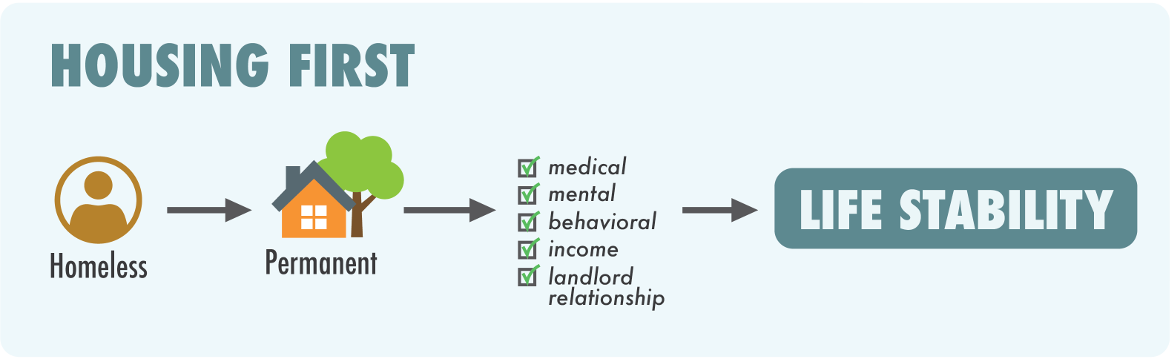
Housing first. Housing First | Homelessness in Marin.
Behind this blog’s playful tone is a serious reality: plastic pollution disproportionately harms those already struggling with homelessness. When we address these interconnected issues, we are not just cleaning up the environment but advancing human dignity.
The good news? Housing First models don’t just solve homelessness—they help reduce environmental exposures too (Tsemberis et al., 2004). It is like getting a two-for-one deal at the social justice store!
By integrating environmental justice into social work practice, we can create more effective interventions for homeless populations while addressing plastic pollution. Now that is what I call working smarter, not harder!
References
- Badiaga, S., Raoult, D., & Brouqui, P. (2018). Environmental health hazards and street homelessness: A systematic review of health outcomes. The Lancet Public Health. https://doi.org/10.1016/S2468-2667(18)30053-7
- Bullard, R. D. (2008). Dumping in Dixie: Race, class, and environmental quality (3rd ed.). Westview Press. https://eswnonline.org/resource/dumping-in-dixie-race-class-and-environmental-quality
- Editor, C. (2024). Pollution in the Sacramento River and hope for its future. Earth5R. https://earth5r.org/pollution-in-the-sacramento-river-and-hope-for-its-future/
- Cushing, L., Morello-Frosch, R., Wander, M., & Pastor, M. (2015). The haves, the have-nots, and the health of everyone: The relationship between social inequality and environmental quality. Annual Review of Public Health. https://doi.org/10.1146/annurev-publhealth-031914-122646
- Dominelli, L. (2012). Green social work: From environmental crises to environmental justice. Polity Press. https://www.researchgate.net/publication/275306867_Green_Social_Work_From_Environmental_Crises_to_Environmental_Justice
- Gutberlet, J., & Uddin, S. M. N. (2018). Household waste and health risks affecting waste pickers and the environment in low- and middle-income countries. International Journal of Occupational and Environmental Health. https://doi.org/10.1080/10773525.2018.1484996
- Hammoud, M. A., & Hendrickson, Z. M. (2020). Charitable food distribution and plastic pollution: Unintended consequences in homeless communities. Social Problems. https://doi.org/10.1093/socpro/spaa031
- Housing first. Housing First | Homelessness in Marin. (n.d.). https://housingfirst.marinhhs.org/housing-first
- Jones, P., & Jenkins, K. (2021). Intersectional analysis of environmental injustice: Pollution exposure among homeless populations. Environmental Justice. https://doi.org/10.1089/env.2020.0056
- Kemp, S. P., & Palinkas, L. A. (2015). Strengthening the social response to the human impacts of environmental change. American Academy of Social Work and Social Welfare. https://grandchallengesforsocialwork.org/wp-content/uploads/2015/12/WP5-with-cover.pdf
- Kushel, M. B., Vittinghoff, E., & Haas, J. S. (2001). Factors associated with the health care utilization of homeless persons. Journal of the American Medical Association. https://doi.org/10.1001/jama.285.2.200
- Leibler, J. H., Nguyen, D. D., León, C., Gaeta, J. M., & Perez, D. (2017). Personal hygiene practices among urban homeless persons in Boston, MA. International Journal of Environmental Research and Public Health. https://doi.org/10.3390/ijerph14080928
- Los Angeles Times. (n.d.-b). Homelessness declines in L.A. and countywide. Los Angeles Times. https://enewspaper.latimes.com/infinity/article_share.aspx?guid=63e1e607-0868-4f87-8719-eeed20932339
- McKinnon, J. (2008). Exploring the nexus between social work and the environment. Australian Social Work. https://doi.org/10.1080/03124070802178275
- Miller, S. E., Hayward, R. A., & Shaw, T. V. (2019). Environmental shifts for social work: A principles approach. Journal of Social Work Education. https://onlinelibrary.wiley.com/doi/10.1111/j.1468-2397.2011.00848.x
- Powers, M. C. F., Engstrom, S., & Tashima, N. (2018). Radical collaboration in social work: Lessons from environmental governance for community practice. Journal of Community Practice. https://academic.oup.com/sw/article-abstract/65/1/29/5673351?redirectedFrom=fulltext
- Schlosberg, D. (2007). Defining environmental justice: Theories, movements, and nature. Oxford University Press. https://global.oup.com/academic/product/defining-environmental-justice-9780199286294
- Teixeira, S., & Krings, A. (2015). Sustainable Social Work: An Environmental Justice Framework for Social Work Education. Social Work Education. https://doi.org/10.1080/02615479.2015.1063601
- Tiller, A., Desai, S., & Goldberg, E. (2019). Household plastic exposure and chronic disease risk among vulnerable populations. Environmental Research. https://doi.org/10.1016/j.envres.2018.12.042
- Tsemberis, S., Gulcur, L., & Nakae, M. (2004). Housing first, consumer choice, and harm reduction for homeless individuals with a dual diagnosis. American Journal of Public Health. https://doi.org/10.2105/AJPH.94.4.651
- Wright, S. L., & Kelly, F. J. (2017). Plastic and human health: A micro issue? Environmental Science & Technology.. https://doi.org/10.1021/acs.est.7b00423
 #WestCOMSW