Middle- and upper-class white environmental activists are often the face of the fight against the climate crisis. People touting that they were able to fit five years of trash into one Mason jar or selling seven reusable sandwich bags for $100 can make living more sustainably feel like an unattainable goal for low-income and marginalized communities. Lack of diversity in climate protection activism and white supremacy has reserved “saving the environment” for dominant social groups and industries, despite Black Indigenous People of Color (BIPOC), low-income communities, and agricultural and other outdoor workers being those most impacted by increasing natural disasters and rising temperatures.
Limited inclusion of diverse perspectives extends beyond those we see on social media talking about what they are doing to live more sustainably. A survey from the University of Connecticut revealed that only 39% of environmental non-government organizations (NGOs) and foundations had diversity plans in place, and only 26% and 13%, respectively, has diversity managers in place. Further research identified that as of 2014, only 3% and 13%, respectively, of the top three positions at environmental NGOs and foundations were held by BIPOC individuals. In a surge of employment in environmental agencies between 2011 and 2014, only 17% were BIPOC folx.
University students of color who are interested in climate advocacy are seeing the impacts of this whitewashing in their education. Columbia University student Ella Koscher wrote about her peers’ experiences in the classroom of not seeing themselves represented, and even excluded, from conversations of science and environmental change. Students expressed feeling that their racial and ethnic identities are not seen in the climate activism world because of a disconnection from the earth and a greater focus on more immediate financial or safety needs due to historical and persistent discrimination and marginalization. Indigenous scholars Megan Bang and Ananda Marin identify this exclusion as a direct result of dominating narratives created by white/human supremacy, settler colonialism, and capitalism. In an education system meant to raise children who can achieve the “American dream” of a steady job and white-picket fence grounded in individualism, Bang and Marin do not see a way that human and earth collective good can be attained. Their call to action involves returning to an Indigenous worldview that values reciprocity between humans and non-human beings and a willingness to adapt in the face of natural – or anthropogenic – change, “We could learn to do other things if we create the conditions and the values for it.”
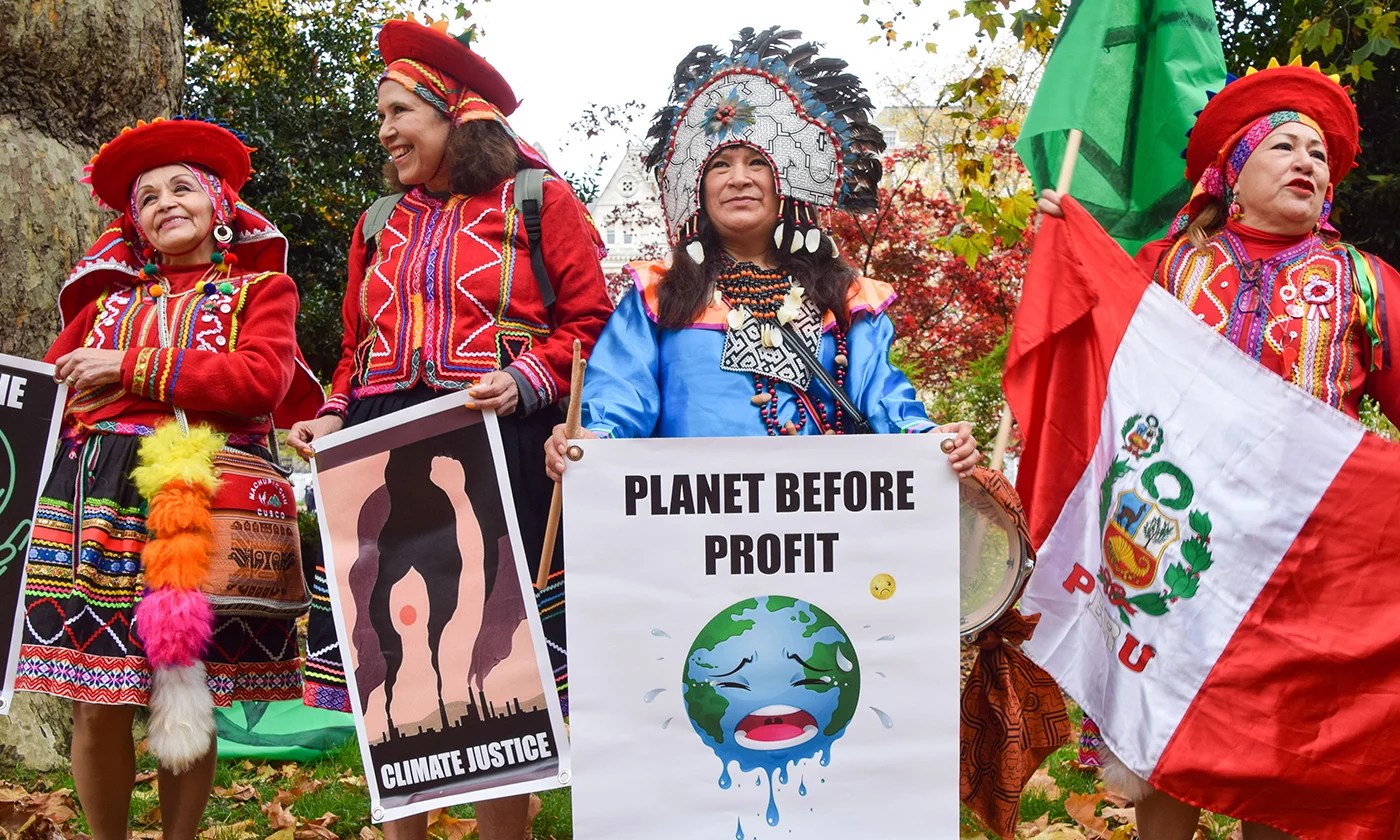
Indigenous communities have been in harmonious relationship with the land for thousands of years. Practices in weather prediction, agricultural, and non-agricultural sectors such as crop rotation, food storage, migration, and societal development grounded in nature-based spirituality have long protected the earth and these communities. Despite a horrific history of colonialism, Indigenous people still manage 25% of the world’s land and 80% of the world’s biodiversity. Because of their sustainable and reciprocal practices, this land is healthier than any stewarded by non-Indigenous populations.
Given the successful and sustainable land management practices grounded in wisdom and interconnectedness by Indigenous groups, it is clear we need to follow their lead in addressing the climate crisis instead of leaning on white academic researchers in the Ivory Tower or social media influencers advertising zero-waste consumerism. The non-profit If Not Us Then Who lays out the five demands global Indigenous communities have of dominant groups looking to participate in environmental advocacy:
- Recognition to Land, Territories and Resources
- Consent
- Zero Violence
- Direct Funding
- Ancestral Knowledge
The ask lies in acknowledging ancestral lands of Indigenous communities and giving them voice and power in what happens with the earth they have cared for. Much of this recognition will happen on a national and international government level. However, there are things social workers can do on micro, mezzo, and macro levels to lift up Indigenous voices and participate in the model of sustainable practice they have set out for us. Volunteering and engaging with grassroots and non-profit organizations such as If Not Us Then Who, Indigenous Climate Action, the Indigenous Climate Hub, and the Centre for Indigenous Environmental Resources brings more awareness to the work already being done by Indigenous activists and organizers. In our local communities, we can engage in sustainable community gardening practices and urge our legislators to protect our wilderness. On a human-to-human level, we can encourage connection and validate the grief of natural landscapes that no longer exist and traditions that have been lost as a result of structural inequities.
It is time for white, wealthy communities to do more than use reusable straws and grocery bags. We have a responsibility to connect across cultures to ensure a healthy earth for the next generations.

Learn more:
Bang, M., Marin, A., Wemigwase, S., Nayak, P., & Nxumalo, F. (2022). Undoing human supremacy and white supremacy to transform relationships: An interview with Megan Bang and Ananda Marin. Curriculum Inquiry, 52(2), 150–161. https://doi.org/10.1080/03626784.2022.2052635
Beasley, M. A. (2017). Beyond diversity: A roadmap to building an inclusive organization [Data set]. Green2.0. https://www.diversegreen.org/research/beyond-diversity/
Centre for Indigenous Environmental Resources. (n.d.). Land is memory. Water is sacred. All living things are connected. https://yourcier.org/
Dorji, T., Rinchen, K., Morrison-Saunders, A., Blake, D., Banham, V., & Pelden, S. (2024). Understanding How Indigenous Knowledge Contributes to Climate Change Adaptation and Resilience: A Systematic Literature Review. Environmental Management (New York), 74(6), 1101–1123. https://doi.org/10.1007/s00267-024-02032-x
Environmental Protection Agency. (2025). Climate change and human health: Who’s most at risk?. https://www.epa.gov/climateimpacts/climate-change-and-human-health-whos-most-risk
Goodful. (2019, March 14). How I fit 5 years of my trash in this jar [Video]. Youtube. https://www.youtube.com/watch?v=ZT0uqEPzbd0
If not US then who?. (2025, April 29). If not us then who?. https://ifnotusthenwho.me/
Indigenous Climate Action. (n.d.). Climate justice. Indigenous-led. https://www.indigenousclimateaction.com/
Indigenous Climate Hub. (2025). Indigenous climate hub: Climate change adaptation. https://indigenousclimatehub.ca/
Koscher, E. (2017, November 21). Whitewashed: The lack of diversity in environmental studies. The Eye. https://www.columbiaspectator.com/the-eye/2017/11/21/whitewashed-the-lack-of-diversity-in-environmental-studies/
Stewart, J., Gosling, J., Corrigan, C., Jonas, H. C., Zanjani, L. V., & Rubis, J. (2021, May 19). A global spatial analysis. Territories of Life. https://report.territoriesoflife.org/global-analysis/
Taylor, D. E. (2011). RESEARCH ARTICLE: Racial and Gender Differences in Job Mobility and Wages of Employees in Environmental Organizations. Environmental Practice, 13(4), 370–385. https://doi.org/10.1017/S146604661100038X
Townsend, J., Moola, F., & Craig, M.K. (2020). Indigenous peoples are critical to the success of nature-based solutions to climate change. FACETS, 5, 551-556. https://doi.org/10.1139/facets-2019-0058
 #WestCOMSW