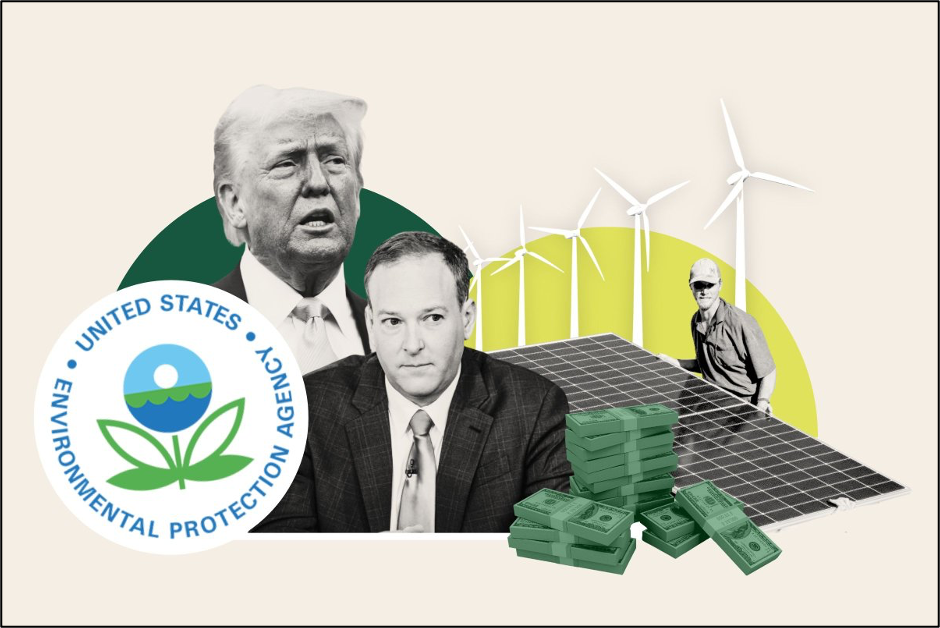
As of March, the Trump Administration, alongside billionaire Elon Musk and appointed EPA Administrator Lee Zeldin, has dismantled hundreds of environmental grants worth $1.7 billion [1]. For the administration and for the everyday American wanting to see less federal debt, this seems to be a terrific success. No more overspending! Why would we waste our time disbursing money to vulnerable nations like Peru that experience extreme weather and sea-level rise when those funds could be used to boost our market and federal reserves? Surely, these policies and federal roles will generate long-term recovery for the American people—except it may do the opposite, thanks to the state of our planet.
A report from the NOAA National Centers for Environmental Information in 2023 [2] highlights that our economic relationship with climate change is worsening, demonstrating an estimated $92.9 billion in damages and recovery work (much more money than DOGE has retrieved) and thousands of lives lost between 2017 and 2024 due to climate impacts. It is within the last two administrations that we have observed record-setting annual temperatures and sea-level rise, the earliest category five hurricane to hit the southeast coast, and increases in extreme weather frequencies for wildfires, tornadoes, floods, and droughts [3]. The investment response to the climate crisis under the Biden Administration is completely polarized compared to the Trump Administration, which highlights our divided political landscape for climate initiatives.

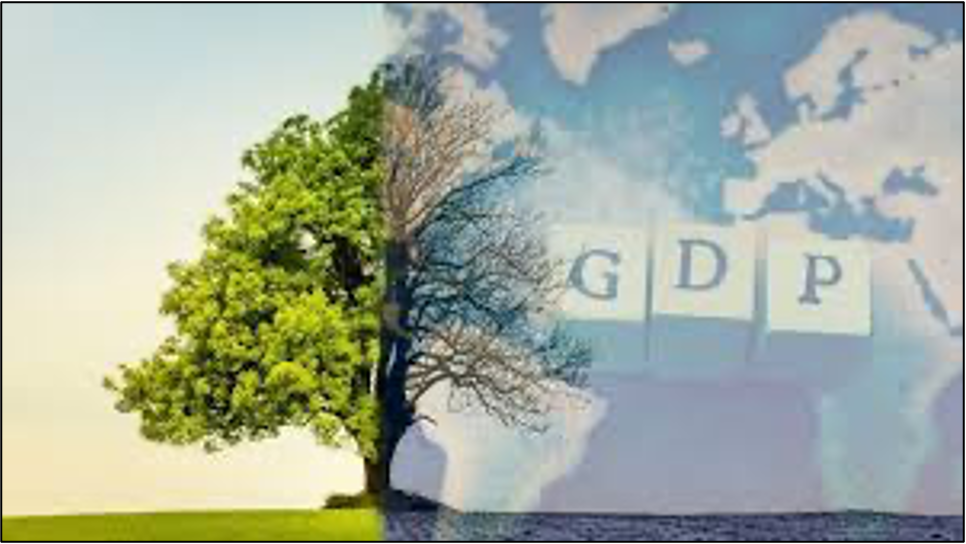
Arguments for under-prioritizing the climate crisis have been deeply rooted in theory of consumer capitalism and an American nationalist lens that rebukes the ideology of economic support for vulnerable allies [4]. The American economy relies significantly on increasing citizen and government investment and internal consumption under a free market. We as a nation have done a steady job of tripling our annual consumption of individual product and have doubled our gross domestic product (GDP) in the past 50 years [5]. A stronger GDP is a sign of a stronger economy. Trump’s 2025 tariff plan seeks to draw back foreign consumption and keep manufacturing, oil, and minerals on American soil, even if it means accessing protected park systems. Not only does this plan represent projected decreases to our annual GDP from prestigious scholars [6], but it relays significant distress for the state of global carbon emissions and land protection, as the U.S. is already a powerhouse for global air pollution and mass infrastructure. Climate change has no borders; this is a global crisis that has reached many vulnerable nations decades ago. Nationalist ideology to withdraw and privatize our investments will do no good when we lay witness to the long-term climate impacts that are being denied by the current administration. If we want to pander to this ideology, imagine the blows to American taxpayers when the next hurricane season dismantles the latest state infrastructure plans and crashes down white-picket-fence homes that serve as the American dream?
Trump is not the first President elect to deny climate intervention and will not be the last. However, his current time in the Oval Office boasts a unique paradigm to American governing power dynamics in which some of the highest-earning members of this nation represent citizens that are struggling to contribute to our free market. Historically, republican leaders represent the word of the working person. Under this oligarchy, President Trump drives home values of consumption and nationalism of a traditional republican base with deeply rooted implications of climate injustices. However, one could argue that Trump’s representation of the wealthy disconnects him from everyday climate turmoil while relaying hypocritical messages of ‘bootstrap’ resilience to climate disasters that the top 1% are less exposed to. Impoverished communities are far more likely to be impacted by climate events [7] that are anthropogenically developed by the nation’s highest earners at a disproportionate rate [8]. Not only does this represent a history of ecological racial injustices in the U.S but also serves as an example of how climate change does not listen to our political agenda. Populations that have historically aligned with republican values of protecting family wealth and the American workforce, like farming and manufacturing communities, are highly vulnerable to climate events that could shatter some our nation’s greatest contributors to the federal GDP. Droughts and disruption of topsoil impact crop seasons for the local MAGA farmer and increased natural disasters are prone to cause massive damage to manufacturing facilities employing the republican mom of three kids. This is a pivotal time in our history when we can start to ask- will class systems play a greater role in climate opinions than a red or blue shirt, and how can this unify working-to-middle class American people in ecological policy discourse?
Surprisingly, this may already be happening. According to reporting from NPR [9], younger generations of republicans are more likely to align with climate concerns and more discourse is being introduced on a national scale, such as a climate showing at the Republican National Convention in 2024. Populations like farmers, who rely on federal subsidies for emission control and bountiful crops, are demanding more discourse from representatives who threaten to cut these benefits and safety procedures [10]. Members of the legislative branch are following suit against the misrepresentation of the climate crisis from the executive chief. According to a report from the Yale Program on Climate Change Communication [11], over half of identifying republicans surveyed view the climate crisis as a concern of cautionary measure that requires intervention, even if economics ranks higher on their list of concerns [12]. What if our discourse welcomed more active listening and acceptance that a thriving national and global economy does not exist without a thriving planet and vice versa? Acceptance and less hostile communication from both political parties is the first step in nonpartisan urgency to address this crisis. What we are witnessing is more Americans being more mentally, physically, and economically vulnerable from climate impacts. In this unfortunate exposure, we could observe a unified working-to-middle-class demanding urgency from the federal government to answer the call to ethical climate investment and intervention, practices that justifiably serve the people and avoid an advancement of 0.7% cuts to GDP for every 1ºF increase in global warming [13]. With optimism and a prayer, I begin to wonder if our unity begins with resistance to the lashing of investment we observe by the day.
Resources:
[1] EPA Press Office. (2025). EPA Administrator Lee Zeldin Cancels 400+ Grants in 4th Round of Cuts with DOGE, Saving Americans More than $1.7B. EPA. https://www.epa.gov/newsreleases/epa-administrator-lee-zeldin-cancels-400-grants-4th-round-cuts-doge-saving-americans
[2] NCEI. (2025). Billion-dollar weather and climate disasters. Billion-Dollar Weather and Climate Disasters. https://www.ncei.noaa.gov/access/billions/
[3] WMO Press. (2023). 2023 shatters Climate Records, with major impacts. World Meteorological Organization. https://wmo.int/news/media-centre/2023-shatters-climate-records-major-impacts
[4] Walt, S. M. (2010). Foreign policy: America’s superiority complex. NPR. https://www.npr.org/2010/05/14/126827639/foreign-policy-americas-superiority-complex
[5] Manyika, J., Pinkus, G., & Tuin, M. (2020). Rethinking the future of American capitalism. McKinsey & Company. https://www.mckinsey.com/featured-insights/long-term-capitalism/rethinking-the-future-of-american-capitalism
[6] Penn Wharton Budget Model. (2025, April 10). The economic effects of President Trump’s tariffs. https://budgetmodel.wharton.upenn.edu/issues/2025/4/10/economic-effects-of-president-trumps-tariffs
[7] Neimanas, N. (2022). Historical, economic, and political dimensions of environmental racism. Journal of Poverty, 28(3), 230–243. https://doi.org/10.1080/10875549.2022.2128981
[8] Oxfam. (2023). Top 5 ways billionaires are driving climate change. https://www.oxfamamerica.org/explore/stories/top-5-ways-billionaires-are-driving-climate-change/
[9] Bustillo, X. (2024). Climate hasn’t been core to the GOP. these conservatives are trying to change that. NPR. https://www.npr.org/2024/07/19/nx-s1-5041975/young-republicans-advocate-climate-action
[10] Neuman, S. (2022). As farmers split from the GOP on climate change, they’re getting billions to fight it. NPR. https://www.npr.org/2022/09/17/1121983842/farmers-climate-change-inflation-reduction-act
[11] Ballew, M., Carman, J., Rosenthal, S., Verner, M., Kotcher, J., Maibach, E., & Leiserowitz, A. (2023). Which Republicans are worried about global warming? Yale Program on Climate Change Communication. https://climatecommunication.yale.edu/publications/republicans-worried-about-global-warming/
[12] Oliphant, B. (2018). Conflicting partisan priorities for U.S. foreign policy. Pew Research Center. https://www.pewresearch.org/politics/2018/11/29/conflicting-partisan-priorities-for-u-s-foreign-policy/
[13] Jina, A. (2022). Climate change and the U.S. Economic Future. EPIC. https://epic.uchicago.edu/area-of-focus/climate-change-and-the-us-economic-future/#:~:text=Economic%20Impact,to%20adapt%20with%20larger%20damages.
 #WestCOMSW